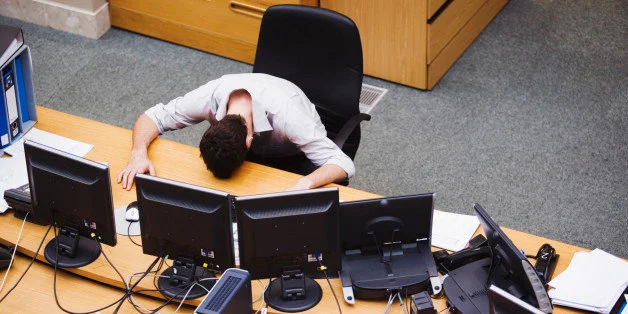
Your office is aging you -- and faster than you'd think. Hours of sedentary, stressful work under bad lighting is hardly good for anybody's health. To help you better deal with your surroundings, we've put together a list of five ways the office is making you older -- and what you can do about it.
Sitting too long can lead to disability.
A recent Northwestern University Feinberg School of Medicine study showed that people ages 60 and older may face a higher disability risk for every one hour they spend sitting -- even if they get moderate exercise. In other words: If you had two 65-year-old women, but one sat for 12 hours a day and the other sat for 13 hours a day, the one who sat for 13 hours a day would have a 50 percent higher risk of disability than the woman who sat 12 hours a day, the study found. The results from another study on the effects of sitting on life spans released in 2012 were even more sobering: An hour of TV watched after age 25 is associated with a reduced life expectancy of 21.8 minutes. Some ways to cut down on sitting time: Stand up when you talk on the phone or attend a meeting, or try parking farther from a store or restaurant to increase the amount you have to walk. (And you wonder why so many people are asking employers for standing desks!)
Slouching over a computer is linked to everything from stomach troubles to high blood pressure.
Remember when your mom told you to stand up straight? Well, sitting up straight may be best as well. Experts agree that poor alignment of the head, neck, shoulder and back leads to pain. If that weren't enough, too much time at the computer has been linked with sleep troubles as well. And sleep troubles not only impact one's memory, but also may cause skin to age faster. To avoid the eternal desk slouch, experts recommend a wide variety of stretching exercises.

Staring at paperwork or a computer screen can strain eyes.
Does your focus ever become blurry after hours in front of the computer? You're not alone. Almost 70 percent of U.S. adults say they have experienced some of the symptoms of digital eye strain, according to a survey conducted for the Vision Council, a trade group for vision care products and services. Eye strain has been linked to an increased risk of glaucoma. It also can lead to a scratchy sensation, a symptom of dry eyes. Since eyes are the first thing people see when looking at you, dry and/or red eyes can make you look tired and older. To combat the problem, try these five-minute fixes designed to brighten up your eyes.
Stress associated with working long hours in an office can speed up the aging process.
Ever wonder if work was taking years off your life? Well, it very well might be. A 2012 study illustrated the impact that job stress can have on certain sections of our DNA called telomeres, which have been linked with longevity. The data, researchers said, show that work-related exhaustion could actually be linked with faster rate of biological aging. Stress also can impact brain power, lead to chronic health issues, and raise your risk of stroke. To naturally reduce stress, try these five research-proven strategies.

Exposure to artificial light over a long period of time may harm eyes and skin.
Office workers may be exposed to some UV and blue light from various lamps for many hours a day. This is hardly a good thing as this over-illumination can lead to stress, fatigue, high blood pressure, and other health concerns. Indeed one recent study out of Stony Brook University found that compact fluorescent light (CFL) bulbs can damage skin cells, making your skin look older. Experts advise people to avoid using these bulbs at close distances, noting they are safest when places behind an additional glass cover. The good news? The effects of short-term exposure to UV from artificial light are negligible, according to European Commission experts.
Comments